
Elevate prevailing wage labor compliance,
streamline administrative processes, and focus on
project delivery with B2Gnow’s eComply solution.



Elevate prevailing wage labor compliance,
streamline administrative processes, and focus on
project delivery with B2Gnow’s eComply solution.
As public agencies and organizations balance the need for inclusivity with the need for legal defensibility, the landscape for small business enterprises (SBEs) working on government projects is becoming more complex.
B2Gnow recently sat down with industry expert John Chapman to explore the current state of the SBE environment. Chapman is a Solutions Architect with B2Gnow and has worked with a wide array of organizations such as state DOTs, cities, counties, universities, and health systems to help them optimize their use of software to enhance their diverse supplier certification and compliance programs.
Before joining B2Gnow, Chapman led agency accountability for the New York City M/WBE program.
Find out what Chapman shared regarding SBE certification, program success, and best practices for agencies looking to provide genuine value to the small business community with resilient, scalable SBE programs in the interview below.
What defines a Small Business Enterprise (SBE) in the U.S.?
Definitions for what a locality defines as an SBE vary significantly because most can choose to set their own thresholds for what constitutes an SBE.
The Small Business Administration (SBA) offers a guide for small businesses looking to work on government contracts, but diverse business enterprises or DBEs use a more narrow standard of a definition for SBE. To put it more simply, 99% of DBEs are small businesses, but not every entity decides to be certified as an SBE.
Generally, these definitions are based on employee counts – such as 125 employees or fewer – or industry-specific North American Industry Classification System (NAICS) codes. These codes are used by businesses and government agencies to classify companies by their primary economic activity.
Localities often adjust these standards to align with their specific economic goals and the size of businesses they aim to support. The SBE standard for NYC will be different from a smaller city because of the size and needs of the locality.
What should be considered when thinking about becoming a certified Small Business Enterprise (SBE) in the U.S.?
If you own and operate a small business and are thinking of getting into the government procurement space, there are some important considerations as you evaluate public-sector agencies.
First, find out which agencies, authorities, or other types of public entities buy the goods or services you provide. Most public entities are required to post solicitations and awards online, so it’s easy to find out.
Second, determine if your firm’s capacity aligns with the agencies’ demand. For example if you’re a landscape architect and your local department of parks and recreation typically awards contracts to landscape architects in the $3 to $5 million range, ensure you can deliver your services at that level. This includes important considerations like bonding and insurance requirements.
Also try and determine if the goods or services you sell are needed by your local public entities, but typically obtained through subcontractors working under larger prime contractors.
Subcontracting can be a great way to get your foot in the door because the requirements are not as onerous and you can gain valuable experience.
Finally, most local public entities will also offer small or micro purchases, which are sometimes targeted opportunities for small businesses. Goods and services procured through these methods generally require less competition and are solicited at smaller volumes, thereby making them easier to execute. Typically, these small or micro purchases require lower insurance requirements as well.
What should cities, counties, states and other public-sector entities consider when thinking about establishing a Small Business Enterprise (SBE) program?
In my experience there are some important areas to consider first, especially surrounding perceived value and feedback loops. These two areas are always going to be a part of determining a program’s success.
You need enough firms to believe the program offers a big enough benefit to justify the level of effort it takes to apply, obtain, and maintain SBE certification.
Ironically, while many municipalities and elected officials want a large number of certified firms so they can tout that as one success metric, individual SBEs on average will see a smaller slice of the pie as the number of SBEs grows.
Alternatively, if benefits from an SBE program are concentrated among a small number of firms, it can create a negative feedback loop where the community perceives the program as biased for the few and not worth it for them because they are not seeing widespread benefits.
With this negative feedback, small businesses may factor this into their decision to not pursue certification. If enough firms don’t seek certification in your SBE program, agency buyers won’t be able to find qualified businesses to include in solicitations for the goods and services they need.
You can think about it like this, if New York City wants to start a small business program, why would businesses want to get certified? As a vendor, getting certified ties back to the benefits offered through the program. Every sector from private to public offers some level of incentive for small businesses such as lower-priced loans/programs or access to bonding or assistance.
A program has to have perceived value because you share a lot of personal information to get certified – such as your personal taxes – and you want to trust that information won’t get lost or into the wrong hands. There are lots of programs reserved for small and local businesses, but they only perform as well as their quality and perceived value.
Then there is the angle of the community’s perception of the program. If the community hears X amount of dollars were awarded to small businesses, but they only ever hear about 10 businesses that received the funds, then that will create a feedback loop saying there is not enough value, and businesses won’t look to get certified as an SBE.
That is all from the vendor’s standpoint. From a locality’s perspective, they might not want to start a DBE program due to the federal government’s current positioning on diversity, equity, and inclusion. So, they might dissolve or elect not to have DBE programs to avoid attracting attention from the federal government.
These same localities might instead welcome SBE programs because they are more legally defensible than a DBE or minority or woman-owned business (M/WBE) program because they face less scrutiny.
In addition, because approximately 99% of businesses qualify as small, these programs may not significantly decrease competitiveness for specific community members, as they are still competing against the vast majority of the market.
Finally, public contracting requires higher standards—such as specific insurance, bonding, and scale—that differ from private sector work. The amount of paper work and documentation required just to submit a bid, let alone win and get a contract registered or successfully perform on a contract is substantial, so the benefits of the program have to outweigh all of the disincentive to seeking public-sector opportunities.
Why should a business seek SBE certification?
For a business owner, benefits through the program may include access to capital, preferred rates on short-term loans, assistance obtaining bonding, bidding assistance and other capacity building programs like mentor programs, price preferences, and set-aside bids are great incentives.
However, the decision to certify relies on a cost-benefit analysis. A business must weigh the effort of sharing sensitive information—like personal and business taxes—against the actual value and substance the program provides to the community.
A business owner also needs to realize the government hires small businesses, but doesn’t operate like a small business. So, it’s important for a small business to know if they can scale to provide not only what the government contract asks for, but if they can provide, say, 10,000 of what the government asks for and if they can do so as fast as a large business.
Public contracting in general is not for the faint of heart. But to be a certified SBE, it shows a willingness to go through the steps needed to prove you’re willing to go through what it takes, have the ability to scale to the project at hand, and meet the requirements.
If your business can show gross receipts and averages from a period of three to five years, establish it is small, and provide a personal net worth (PNW) statement highlighting that as the business owner you are not wealthy, then you can be on your way to SBE certification.
What are the standard requirements for SBE certification?
SBE program requirements vary by municipality, but they often include business size, personal finances, location, and verification.
For the business size, programs may look at average gross receipts over a specified period or use other size standards. Some programs require a PNW statement to ensure the owner is not what that municipality considers “wealthy” (although typically the net worth of the home is not included in the PNW).
Many localities require the business to be headquartered within their specific city, county, or state. Lastly, business owners need to prove the applicant legitimately owns, operates, and controls the business.
Prime contractors and subcontractors have to be careful to not be perceived as helping too much with the SBE because it can get the business in trouble by looking like the owner isn’t operating his or her own company. These programs often have individuals looking out for levels of corruption, so it’s good to be aware of how something can be perceived.
How can public agencies build resilient and scalable SBE programs?
Resilient and scalable SBE programs need to show their value and the best way to do that is to decentralize operations across multiple agencies like tentacles – the longer the roots or tentacles, the stronger the program.
If it only lives in the small business agency or economic development or diversity space, it can die if funding is moved or leadership changes. When possible, legislation that defines and requires SBE programs also helps ensure it cannot easily be removed or changed with new administrations.
It’s important to keep strong documentation around processes, rules, and procedures – and then making sure that your organization uses the documentation. Should you ever face an audit, you will be prepared with the information necessary.
It’s vital to make sure you use the resources you have and avoid single points of failure. Having redundancy in multiple places helps ensure that should someone with a lot of institutional knowledge leave, there are teams and cross training that have occurred, so business can continue to run as usual.
You want the SBE program to be involved with project managers, accounts payable, and spread across multiple agencies because then it is decentralized and a part of all operations. That gets additional individuals in the locality to be involved in the program, rely on the program, and see the value of the program, which helps solidify its continuation.
From the vendor community angle, you want to also ensure community advocacy groups and different folks are advocating for the program to show its value for different parts of the community. It helps if different parts of the community come together and provide input while also helping increase engagement and involvement from different sectors. When you do this, the SBE becomes a trusted voice in the business community.
Ultimately, if you don’t have results it doesn’t matter how much advocacy you have – the program will die or be deemed not real. So it needs to be enforced, you need people to see and experience its value, and you need to have structure.
For instance, enforcement can mean having something as simple as procurement statistics to show that the SBE is only soliciting certain types of businesses, what the responses were to the solicitation, and why a bid was won or lost. When you track information and provide an analysis of what the SBE is doing and what value it’s bringing, you will understand areas of success and areas of concern.
When you think of resiliency and strength, you need to be tracking. You can’t do analysis if you aren’t getting results and a lack of results will get your program terminated. Clearly define what compliance means for your SBE and track every element of data pertaining to that definition. That way, you can have the data to tell folk how your business is doing when you say it’s compliant.
Why are SBE programs considered more legally defensible than DBE, MBE, or WBE programs?
In the event you have to justify an SBE program in court, it’s often easier because they operate under a lower level of legal scrutiny. Unlike programs designed specifically for protected classes such as MWBEs, SBE certification does not require business owners to prove past discrimination in the marketplace.
What role does technology and AI play in the SBE certification process?
AI is currently in the conceptual stage for these types of programs. The hope is that it will eventually assist in processing applications by synthesizing documentation, identifying inconsistencies, and presenting salient information to human reviewers.
However, agencies are still evaluating whether AI can discern the complexities of certification without becoming cost-prohibitive or losing necessary human oversight.
What we are hoping to see within the certification process is how AI can be used for receipt, review, and decision-making on vendor applications, but keeping humans involved for the final say in the ultimate decision.
Different organizations have different views of how they want to utilize AI and some don’t want to use it at all. With it being in a conceptual phase at this point, there are a lot of layers of understanding to be considered and questions to be answered about how it can be incorporated into processes to do the level of discernment required.
What is the best way to maintain data integrity and security for vendor directories?
This is a delicate balance and challenges many public agencies and organizations face. It’s important for agencies and organizations to make sure the partners they work with understand the necessary precautions to take for data integrity and security.
Publicly available directories provide significant value, but this accessibility makes them targets for phishing and scams. Agencies must manage security by working closely with technology partners to understand exposure risks and implement precautions for sensitive vendor data.
What are the pillars of success for agencies successfully running SBE programs?
Any SBE program is going to need to define compliance and the goals of the program. Business owners will want to engage with the community because you should show that you are there to serve and collaborate within the community.
There are a lot of good minds in a community and while community members might have different thoughts on what they want to happen, it’s great to come together and share thoughts on what you can achieve together.
It’s also important to have strong metrics you can work with and understand because ultimately the metrics are going to show how you are achieving your goals.
If things are going well – or not going well – the metrics are there to help you make necessary changes or adjustments. You also want solid metrics you can share to achieve buy-in, keep engagement, provide feedback, and create a program that continues to evolve and provide value whether it’s year one or year five.
Moving Forward
A resilient SBE program requires a foundation of data-driven metrics to track compliance and success along with a commitment to fostering transparent, collaborative relationships with vendors.
To thrive in today’s environment, building a resilient SBE program requires a foundation of data-driven metrics to track compliance and success, as well as a commitment to fostering transparent, collaborative relationships with vendors.
By integrating these programs across agency operations and maintaining strong community engagement, organizations can ensure their SBE initiatives evolve into trusted, impactful pillars of local economic success.
*The material provided herein was last updated on 9/10/2026. The information stated is not intended to provide legal advice, but rather, for general informational purposes only.
A step-by-step guide to stay organized, meet key requirements, and maintain audit readiness
In this case study, learn how the Civil Rights and Equal Opportunity Department (CREO) for Kansas City, Missouri (KCMO) transitioned from paper-based tracking to an efficient, automated labor and business compliance process using B2Gnow’s eComply prevailing wage labor compliance solution.
Read More to Discover KCMO’s:
Federal, state, and municipal agencies face numerous mandatory reporting requirements related to compliance needs. These reporting requirements generate massive amounts of data that can be difficult to put into easy-to-read reports — especially when using outdated spreadsheets. ٖٖ
However, when agencies have tools to manage, track, and use data (without needing a technical background) they can make faster, more transparent, and more accountable decisions.
That’s where B2Gnow’s Power Analytics comes in.
To monitor program progress/performance, boost compliance and stay ready with defensible data for audits, internal reviews, stakeholder visibility, and regulatory requirements, B2Gnow’s Power Analytics makes it possible to generate actionable insights with near real-time information.
Unlike spreadsheets, Power Analytics provides agencies and organizations with advanced reporting and dashboard capabilities giving the transparency, consistency, and control needed for compliance.
With Power Analytics and its real-time data capabilities, compliance officers can:
Power Analytics’ flexible dashboards and visualizations support audits, investigations, and regular reporting cycles, so compliance officers and other users can bring heightened transparency and visibility across organizations.
In addition, Power Analytics provides:
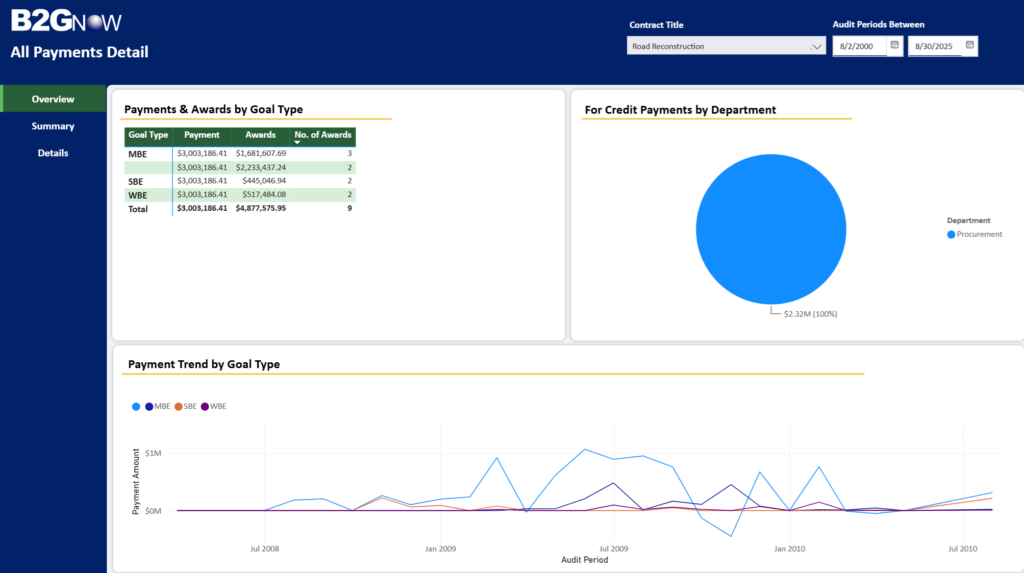
View all payment details and awards by goal types with ease with Power Analytics.
Ultimately, those using B2Gnow’s Power Analytics can track their program performance and make informed, defensible decisions using trusted data sources presented in a format that moves away from spreadsheets and supports documentation and compliance readiness.
*Microsoft and Power BI are trademarks of the Microsoft group of companies
Reliance on spreadsheets to track and analyze data is a common bottleneck in the government space.
Public agencies generate large amounts of data and are required to keep meticulous records for reporting requirements. Yet many struggle to use the data available – especially when it’s only available on spreadsheets.
To ensure these agencies reflect the true impact of all programs running, it’s necessary to move toward a tool capable of taking data and generating actionable insights.
That’s why many public agencies and organizations are using Power Analytics from B2Gnow.
With traditional spreadsheets and the manual effort it takes to keep these up-to-date, the resulting data is often fragmented, making it difficult to prove program success and prepare for audits.
Because stakeholders need to see the outcomes of a program’s success, data that is outdated, hard to access, read, and visualize means the transparency necessary for decision making often isn’t there. This lack of transparency results in delays that can impact those working on community projects.
To further complicate data access and visualization, each individual contributing to spreadsheets increases the chances of missing or deleting data, making errors, and impacting version control.
However, with Power Analytics from B2Gnow, government agencies have a tool that helps measure what matters and visually display data, so all stakeholders have a strategic asset to:
In addition, B2Gnow’s Power Analytics:
With Power Analytics, view all payment details and awards by goal types with ease.
Power Analytics comes with bundled, pre-built reports, including B2Gnow’s Contract Compliance Audit Summaries and Subcontractor Overview Dashboards, so users can instantly feel confident in telling accurate, data-driven stories from day one.
In addition, data fields within Power Analytics align with field names used within the B2Gnow interface, allowing users familiar with B2Gnow to use Power Analytics with ease – even from day one.
Sharing data is also easy.
B2Gnow’s Power Analytics has a free licensing model that includes one creator license with unlimited read-only views, allowing for reports to be shared internally across departments and publicly without restrictions.
With this functionality, real-time reports of economic growth and opportunity, program performance, and goals are easily shared with key stakeholders.
In addition, viewers don’t even need to log in to view reports – it is as simple as accessing a URL.
Plus, data is refreshed nightly, providing the most up-to-date performance snapshots allowing users to identify issues early, document decisions confidently, and demonstrate program integrity.
With Power Analytics, view all payment details and awards by goal types with ease.
The story of any program’s impact is held in the data an agency keeps, so don’t let it get lost in spreadsheets.
Power Analytics ensures the narrative around all programs is unlocked, interactive, tailored, and full of pre-built insights.
With B2Gnow’s Power Analytics, agencies experience the power of reporting designed to meet agency-specific compliance and diversity goals to start making informed, confident decisions organizations need and deserve.
Setting a New Standard for Government Spending
In this interview, John Cardenas, Senior Manager of the Small Business Department at the Port of Portland, redefines shared prosperity by moving past spreadsheets to power massive projects with B2Gnow’s vendor management and compliance software.
Here are the key takeaways from the conversation:
Watch the full conversation to see how this approach is setting a new standard for government spending and changing the lives of local business owners.
Discover how our vendor management, prevailing wage labor compliance, and grant management software solutions help you streamline processes and allow you to deliver greater impact to your community.
Maximizing Impact with B2Gnow Vendor Management and Compliance Software
In this video, listen as John Cardenas, Senior Manager of the Small Business Department discusses how the Port of Portland, OR, transformed operations, stayed ahead of federal policy changes, and uses data to support the area’s diverse small business landscape– all while using B2Gnow’s software solutions for vendor management and compliance.
Watch the full conversation to learn more.
Discover how our vendor management, prevailing wage labor compliance, and grant management software solutions help you streamline processes and allow you to deliver greater impact to your community.
Efficiency Gains in Construction Contracts with B2Gnow
Struggling with manual contract tracking is a common problem in the government space – but not for the Port of Portland in Oregon.
Listen as John Cardenas, Senior Manager of the Small Business Department at the Port of Portland discusses how B2Gnow transformed compliance and project management.
Watch now to see how the Port of Portland achieved the following:
Discover how our vendor management, prevailing wage labor compliance, and grant management software solutions help you streamline processes and allow you to deliver greater impact to your community.
Contract and Labor Standards Division Helps Even the Playing Field with B2Gnow
Jarrett Dillard, Division Manager for Kansas City’s Contract Compliance and Labor Standards, discusses how transitioning from paper-based processes to the combined use of B2Gnow’s vendor management and eComply labor compliance software solutions has revolutionized the department’s ability to monitor construction contracts.
Discover how our vendor management, prevailing wage labor compliance, and grant management software solutions help you streamline processes and allow you to deliver greater impact to your community.


