How B2Gnow Software Champions Compliance and Empowers Agencies

In the ever-evolving landscape of supplier diversity, recent updates to the Disadvantaged Business Enterprise (DBE) and Airport Concession Disadvantaged Business Enterprise (ACDBE) program have significant implications for organizations aiming to maintain compliance and promote equitable business practices. One such update includes an increased personal net worth (PNW) cap for owners to be eligible for the programs. This article will explore this particular update, its impacts, and how B2Gnow, the leader in supplier diversity software, prevailing wage labor compliance, and grant management solutions, helps organizations navigate these changes effectively.

Understanding the Revised Personal Net Worth Limitations

A key part of the Disadvantaged Business Enterprise (DBE) program and Airport Concessions Disadvantaged Business Enterprise (ACDBE) program, administered by the U.S. Department of Transportation (USDOT), is the Personal Net Worth (PNW) Cap. This requires that the personal net worth of the majority owner(s) of the firm not exceed the new PNW cap to remain eligible to participate in DBE/ACDBE programs. The PNW component recently gained attention with the USDOT’s 2024 DBE/ACDBE Rule Change, which increased the PNW cap for the first time since 2011 and updated the net worth calculation. The department also committed to revising the PNW cap every 3 years on the anniversary of the initial adjustment.

Supporting DBE and ACDBE Compliance with Powerful Software Tools

Key features and benefits:

  1. Revised Personal Net Worth Cap: Previously set at $1.32 million, the personal net worth cap for DBE certification has been adjusted to $2.047 million. This revision is critical, as it directly impacts the eligibility of many businesses seeking DBE status. The change aims to better represent the economic realities faced by disadvantaged groups.
  2. Transparency in Calculations: The new rules demand greater transparency in the personal net worth calculations, ensuring that businesses cannot artificially deflate their financial status to gain eligibility. This move enhances the integrity of the DBE program and ensures that support reaches those who genuinely require it.
  3. Updated Form: The PNW form itself has been updated. It’s important for applicants to use the latest form to avoid their application being returned to them. B2Gnow’s PNW module includes the new form in digital format. The module generates a PDF and prints copies in USDOT format for signature and notarization.

    These updates are pivotal in promoting a more equitable landscape, but they also introduce complexities for organizations striving to stay compliant.

Meet B2Gnow’s Refreshed Personal Net Worth Module

The B2Gnow PNW module is an add-on to the B2Gnow Online Application Module that digitizes the application process to provide a simple way for vendors to fill out and submit their PNW information. B2Gnow has collaborated with the USDOT to understand and improve the PNW module in line with recent rule changes, ensuring ongoing compliance. The data is collected electronically, and calculations are performed automatically, making it a smooth and painless process that saves vendors and certifying agencies time and money. Key features and benefits:

  • An integrated location for online applications, certifications and PNW statements
  • Represents the most current version of the PNW form and includes digital representation of the most current rules and regulations
  • Eliminates paper handling and illegible handwriting on paper forms
  • Speeds processes – Automates calculations of assets and liabilities to reduce the likelihood of calculation errors and speed the application process
  • Saves time and effort – guided process for vendors leading up to their application submission ensuring a complete application
  • Utilizes PIN security to keep data separate and out of view of other owners in the case of a multi-owner company
  • Enables documents for signature routing in the system

How B2Gnow Supplier Diversity Software Spearheads Compliance and Assists Organizations

The recent DBE and ACDBE rule updates bring both challenges and opportunities for organizations dedicated to supplier diversity. Understanding the new personal net worth calculations and compliance requirements is essential, and B2Gnow stands out as a critical partner in this journey. With its robust features, including the new Personal Net Worth module, B2Gnow empowers organizations to stay compliant and promote a more equitable business environment.

As the leading provider of business diversity, prevailing wage labor compliance and grant management solutions, trusted by over 400 public agencies, including transits, state departments of transportation, airports, and other entities, B2Gnow provides powerful cloud-based software to more DOT’s, transit authorities and airports than any other software provider and guarantees compliance with both 49 CFR Part 23 (ACDBE) and Part 26 (DBE) regulations.

Offering twenty-five modules, B2Gnow provides a cost-effective and flexible solution that emphasizes vendor self-responsibility in managing and reporting their data, substantially reducing administrative effort. The B2Gnow system offers connections to 200+ certified directories, with most providing real-time status and details. Users can easily search for certified vendors by certification types, work codes, location, and more, ensuring efficient vendor management, sourcing, and compliance. With a wealth of experience spanning over 25 years, B2Gnow continues to evolve to meet the diverse needs of its clients, empowering them to navigate complex supplier diversity and compliance landscapes effectively. Learn more and request a demo.

How to Improve Your Business Inclusion Program in 2025

From spurring local job growth to creating sustainable supply chains, today’s business diversity and business inclusion program managers are well-versed in the magnitude and impact of equitable contracting on DBE (Disadvantaged Business Enterprise), M/W/V/SBE and local businesses within communities across the US.

However, following the recent U.S. Supreme Court’s Students for Fair Admissions (SFFA) Affirmative Action ruling, business diversity and business inclusion programs are under increased scrutiny. Moreover, with the upcoming USDOT changes to the DBE and ACDBE programs, many program managers wonder how their programs will internally support these proposed requirements. Do they have the right supplier diversity and procurement management software in place? Can their staff manage the proposed required process changes?

In 2024, efficiency, adaptability, and impact are the name of the game. Developing and managing a D/M/W/V/SBE or local business inclusion program comes with challenges like limited supplier options, regulatory complexities, formulation and implementation of small, diverse, or local business objectives, obtaining organizational buy-in, and effective expenditure tracking. Achieving success requires actively supporting D/M/W/V/SBE and local suppliers, enhancing outreach strategies, utilizing comprehensive procurement management software, and instilling a firm commitment to diversity and inclusion among stakeholders within your organization. These measures are essential for promoting diversity, backing underrepresented businesses, fostering fair economic growth, and guaranteeing clear and transparent reporting.

As business diversity and inclusion teams across the US look to the new year to address these challenges head-on, they’re more often than not troubled with multiple systems and manual processes to fulfill their objectives and monitor these significant goals; they’re often finding their limited staff resources stuck in repetitive tasks and buried under paperwork. Moreover, they’ve become increasingly aware of the potential projects they could undertake, if not for spending hours manually tracking information – whether it involves vendor outreach, contract bidding, subcontractor payments, certification applications, or renewals. The never-ending effort to create and submit required reports, respond to staff inquiries, find the right certified firms, direct vendors to proper resources, and allay stakeholder concerns about data accuracy can feel like quicksand to your program’s objectives.

Leading state, local, education, transportation, healthcare, general contractors, and more are finding a better way to tackle efficiency, adaptability, and impact into 2024 and beyond. These organizations rely on B2Gnow Business Diversity Software to seamlessly manage, track, and report on their business diversity and inclusion programs. The B2Gnow system is not only a comprehensive procurement management software system that helps business diversity programs easily manage the bidding process from end to end, but it also facilitates the creation of utilization plans, outreach efforts, contract compliance, and more. Here are just a few of the reasons organizations choose B2Gnow:

The single largest searchable system of business diversity certifications in the U.S. – Over 120 certification agencies use the B2Gnow system to certify and track supplier diversity certifications (DBE, ACDBE, MBE, WBE, SDVBE, VBE, SBE, etc.) – this certification data is native and real-time in the B2Gnow system. Plus, B2Gnow imports over 100 other third-party directories into our system.

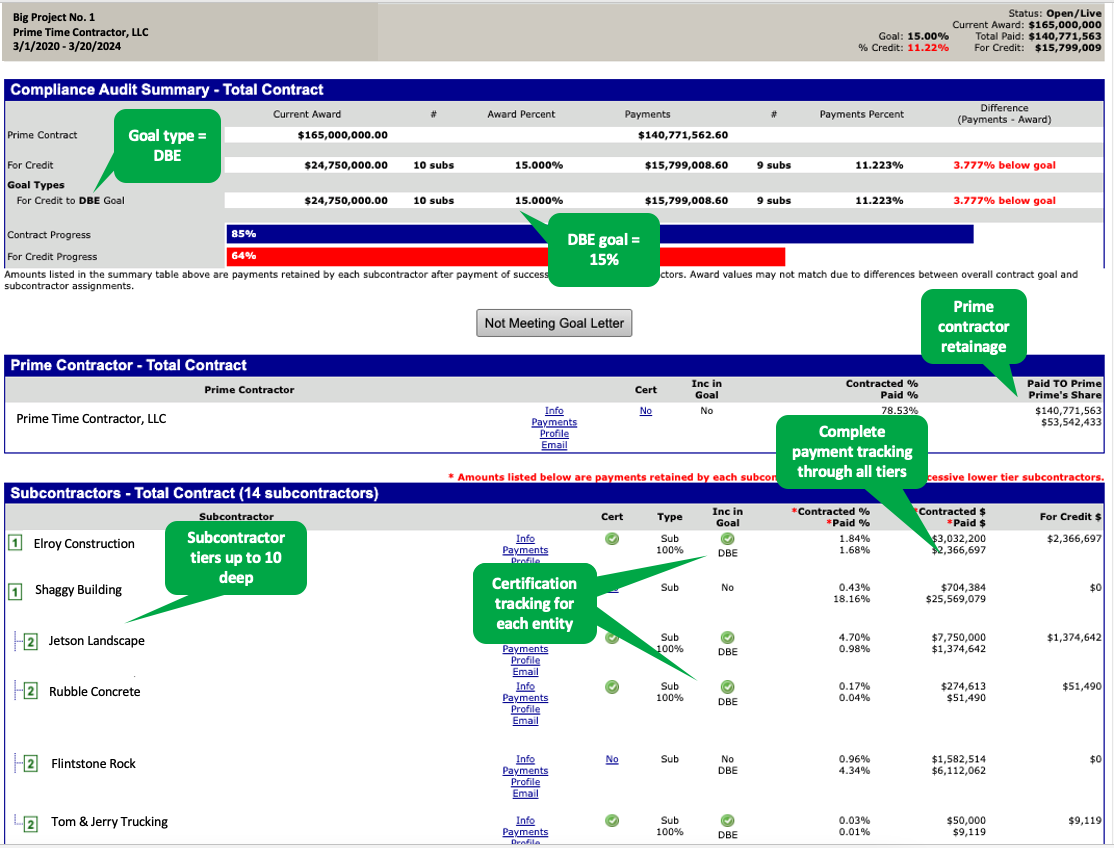
Unparalleled spend and utilization tracking – Through different types of spend and utilization tracking modules in the B2Gnow system, organizations can choose to track spend from tier 1 vendors (spend analysis) to tier 10 (tracking through all levels of subcontractors on a project).

End-to-end bid management – Facilitating cost-effective online bid submission, tabulation, and optional public portal publication, this integrated bid solicitation and end-to-end procurement management software solution streamlines the process. It features dynamic document requirements with amendment acknowledgment, tracks Good Faith Effort (GFE), and seamlessly connects to Utilization Planning and Contract Management modules for comprehensive diversity management. Derived from detailed input and feedback from various organizations nationwide and across industries, the module’s capabilities are designed to efficiently handle the substantial communication challenges in every solicitation. This includes tasks such as identifying and sourcing suitable firms, responding to bidder questions, and managing other administrative actions.

Powerful vendor outreach capabilities – Search, sort, group, and export vendors by various parameters such as certification type, certifying agency, race, gender, and work codes (i.e., NAICS, NOGP, etc.). Better yet, many organizations simply utilize the B2Gnow outreach engine to set up and manage communication campaigns and events to encourage wider participation.

Multiple options for output of results, reports, data, and data visualization– Choose from over 400 standard system reports, PowerBI access, and data libraries (license included), export options, and API/web services. B2Gnow allows organizations to report and visualize their business diversity and utilization data in the formats that best suit stakeholder needs.

Guaranteed compliance now and in the future – Manage complex small/diverse spend tracking compliance and regulatory requirements, including compliance with USDOT, 49 CFR Part 23, and CFR Part 26.

Some of B2Gnow’s most popular modules include:

Baseline Vendor Management – The core B2Gnow system module required for all systems: users/vendors, vendor search, reports, settings, support, connectivity, etc.

Contract Compliance – Manage the financial aspects of your program, including monitoring actual participation versus contract goals and capturing down to tier 10 awards and utilization. Manage and track prompt payment requirements, performance against goals, and CUF reviews.

Online Vendor Registration – Streamline vendor registration while empowering vendors to easily submit required information and documentation electronically. From bidder registration to EEO plans and affirmative action plans, questionnaires are configured specifically to meet each organization’s needs and can accommodate various formats and question types. The module features an automated renewal process for registered firms and allows vendors to submit profile changes anytime for ongoing accuracy.

Outreach & Events – Create “campaigns” to email blast crafted messages to a customized list of any type of vendors (certified, primes, sub, local, etc.). The module also facilitates event management and tracking.

Online Application – Allows vendors to submit certification applications online. The forms eliminate paper/email submissions and give organizations an option to eliminate hardcopy documentation completely. This efficiency reduces review time and ensures that only complete applications are received.

Certification Management – Supports your organization’s review of certification applications, including workflow and review checklists that are configured to support your process. The module helps programs increase standardization and improve the quality of certification application review. Manages expiries and renewals.

Streamline your business inclusion program and procurement processes with B2Gnow, trusted by 400+ customers strong and growing, including 30+ state DOTs, 90+ airports and transits, 100+ cities and counties, and 100+ education, healthcare, general contractors, utilities, and more. We’re standing by, ready to get you onboarded procurement management software that will also help keep you in compliance, empowering your organization to seamlessly automate, manage, track, and report on the requirements of your DBE/ACDBE, small, diverse, or local program. Contact us to speak with an expert and learn more about B2Gnow Business Diversity Software.

Agency Certification: 5 Ways to Improve the Process & Increase Opportunities

From spurring local job growth to building environmentally-friendly supply chains, as a certifying agency, you’re well-versed in the magnitude and impact of inclusive procurement on small, diverse, and women-owned businesses and communities across the US. 

However, your program might be plagued with common challenges often seen across many certifying agencies. These include too many manual processes resulting in piles of paper, never-ending directory updates, and hours spent collecting and verifying information or explaining next steps with vendors. Add a tedious reporting process and concerns about data security to the list, and you’ve got your work cut out! 

This latest article outlines five things today’s leading certifiers do to reclaim their time, optimize resources, and provide a seamless certification experience, increasing opportunities for small and diverse firms to win business.

#1 – Go Digital – Ditch paper processes for good!

Between the collection of applications and all supporting documents, your office is busting at the seams with paper:

  • Paper takes up excessive space, is costly to store, and locating and keeping track of essential documents sometimes seems impossible.
  • Paper documents are easily misfiled, leading to a tedious, all-day game of hide-and-seek for your staff while your vendor patiently waits for approval. (The same vendor who may have mailed or even hand-delivered these documents some time ago. This could be a long process!) 
  • Additionally, paper records are easily compromised. Much of the information you collect from your vendors is confidential. Unauthorized individuals can access these documents if left on tables, filing cabinets, or unlocked storage areas. Issues can also arise during printing. Sensitive information should only be available to those authorized to view it.

The most efficient certifying organizations have realized that shuffling paper is time-consuming and could put them on the wrong side of a security breach. As a result, they are moving their application and approval processes online, reducing staff review time and ensuring only complete applications are received. 

The digital process also reduces the vendor’s time, effort, and expense (and possibly, frustration!) required to apply for certification and maintain active status by allowing easy application completion and online document upload. Completing this streamlined process means more opportunities for these newly certified vendors to win business! Furthermore, a digital approval process could allow authorized staff to create and edit certification records, evaluate approval checklists/audits and documentation, manage certification application dispositions, and publish directory entries, all in a secure environment free from mountains of paperwork! 

#2 – Offer an Online Portal – Delight vendors with one-stop convenience

When it comes to small and diverse businesses, time is money. Your goal as a certifying organization is to help them advance and grow in the community, but you may be asking yourself:

  • Is our agency’s certification process reflective of this effort? 
  • Can vendors and prime contractors easily access certification applications, renewal forms, information about upcoming opportunities, and a searchable vendor directory?
  • Do we have a simple process to ensure that vendor data in our directory is accurate and kept up to date? 

If the answer is no, your vendor experience could be lacking. Additionally, certification processes can be arduous and detailed. An antiquated process could be equally difficult for your staff. There aren’t enough hours in the day for follow-up or repeatedly answering the same questions. Additionally, outdated vendor data (email addresses, phone numbers, LinkedIn pages) can stifle opportunities for certified firms in your directory. For these reasons, you want to ensure your vendors’ experience and interactions with your agency are simple, streamlined, and consistent.

More and more certifying agencies recognize their vendors need a streamlined process and are choosing certification management software that includes vendor portal access. Designed to look like the agency’s website, a vendor portal offers vendors a one-stop shop for all their needs. B2Gnow Supplier Diversity Management software, for example, enables certifying organizations to direct vendors to their portal to not only apply for certification, monitor their application status, and apply for renewals but also to manage current directory information and all communications throughout the process. Imagine the staff hours saved with an online system that streamlines the certification application process and reduces the number of phone calls and emails with vendors, with documentation built in! 

In addition to certification management, the vendor portal enables firms to keep their profiles updated (automated reminder emails can encourage this). It also allows primes, subs, or anyone to access the organization’s certification directory and other approved certified directories to search for vendors by name, zip code, work code, and more. This level of access saves time and frustration for vendors, and offers greater visibility for certified firms. 

#3 Automate, Automate, Automate – Easy approvals and auto-renewals are key

All too often, certification agency staff find themselves struggling with common but severe process pitfalls: 

  • There are not enough hours in the day to keep up with reviewing applications and approving certifications for new vendors. 
  • Antiquated processes involving too many steps and using multiple systems have them running in circles. 
  • Besides the efforts necessary to take good care of these new vendors is the additional ever-looming stress of managing the active firms, including notifying firms of the need to renew, as well as, reviewing expansion and change requests and certification renewals. 

The country’s most successful certifying organizations empower their teams with automation! They’ve found that by implementing a certification management system like B2Gnow, their staff significantly reduced the time spent doing tedious administrative tasks. Besides the conveniences of a public portal and online communication with vendors, dashboards make monitoring the application and certification processes simple. And approval is as easy as the click of a button. In addition, an automated renewal process means less worry about currently certified vendors falling through the cracks. 

#4 – Proactively Grow Your Directory – Find more vendors and encourage program participation

Managing a certification program is no small undertaking, and after all the effort and time spent maintaining your directory, you still seem to fall short on potential suppliers to meet your goals. Questions that keep you up at night include:

  • Do you have enough certified vendors for every necessary work code? 
  • How can we reach more potential vendors to grow our directory? 

The answer is, with the most extensive vendor database, such as B2Gnow’s database of over 1.5 million vendors (approximately 600,000 of them certified), offers an easy way to extend your reach and inform businesses in your community about your program! Search multiple parameters, including zip code, work codes, and more, and easily craft a message using the Outreach and Events module. It allows users to create “campaigns” to send email messages to a customized list of vendors and monitor the interaction. With nearly 200 certifying organizations already using B2Gnow, it’s a simple process to target firms operating in your market that are certified by others but not certified within your program. Besides certification program outreach, many organizations use the system to notify vendors about upcoming opportunities. The module also facilitates event management for online attendee registration, RSVP, and attendance tracking.

#5 – Produce More Accurate Reports With Less Effort – Generate detailed, automated reports in seconds

Your agency’s certification program is only as good as the reports you can provide. Unfortunately, for busy program directors, finding time to assemble these reports for stakeholders can mean long hours of cutting and pasting data from multiple spreadsheets, plenty of calculating and recalculating, and perhaps a bit of nail-biting over lost hours and accuracy concerns. 

Top certification agency professionals rely on certification management systems for greater accuracy, efficiency, and overall program visibility for aggregate reporting. An all-in-one-certification management system, like B2Gnow, offers a robust reporting library and enables certifying agencies to easily report on everything from applications received and certification status to certification officer assignments and processing time statistics. Additionally, a best-in-class certification management system allows for the analysis and reporting of certified vendor data with a click of a button to track firms by ethnicity, gender, location, work code, and more. Furthermore, it easily creates visually appealing reports and dashboards to better demonstrate their program’s success. 

No matter the size of your team, the availability of resources, or other challenges with automating, streamlining, or reporting on our program,  today’s leading certifiers are finding a better, more efficient way to manage their certification process and provide a seamless certification experience that increases opportunities for small and diverse firms to win business. More than 150 certifying organizations rely on B2Gnow Supplier Diversity and Certification Management Software to manage their programs’ complex needs. From certification management and diverse vendor search access to the largest certified supplier database in the world, to data enhancement tools that qualify and quantify current supplier data, to spend analysis capabilities that go deeper to understand diverse supplier data, to construction contract compliance that easily track and report supplier diversity on capital construction contracts, B2Gnow allows supplier diversity professionals to focus on meeting diversity goals, not chasing paper. Learn more and take a tour of B2Gnow Supplier Diversity Software.

7 Signs Your DBE Program Is “Leaking” Efficiency

Perhaps you’ve noticed that some of your DBE Program’s current processes just aren’t as efficient as you’d like. You’ve periodically considered that improvements could be made to positively impact your DBE program (and likely make your typical workday a lot easier).  After all, you have important community and diversity goals to meet and are simply tired of chasing paper.  Moreover, you’re becoming keenly aware of the projects you could accomplish if you weren’t spending hours manually tracking information which, depending on your organization and responsibilities, could range from subcontractor payments to certification applications and renewals. Working until the eleventh hour to create and submit critical reports, doing multiple follow up with suppliers, and spending far too much time running in circles with multi-system chaos, questioning the accuracy of your data has become the norm.

 Common Inefficiencies Holding Back Your DBE Program’s Performance

You’re struggling with multitier tracking and reporting.

Without the proper tools in place, your visibility could be shallow. For example, your program might be successfully tracking and reporting on Tier 1 or prime DBE suppliers; however, you know you’re missing out on the opportunity to accurately report on your entire DBE utilization, as your subs may also be subcontracting with DBE businesses. The problem is effectively tracking and reporting on those deeper tiers, whether manually or through a multitude of different systems, seems impossible.

You have critical, timely reports you need to produce.

The ever-looming Uniform Report is your bi-annual nemesis! There doesn’t seem to be any simple way to get through it, and with NPRM proposed rule changes on the horizon, an accurate, timely submission will not get any easier. Besides the Uniform Report, depending on your industry and program goals, there are likely specific compliance goals, internal requirements, or mandated reports that you need to produce.  To generate these reports, you need a consistent and efficient way to collect and accurately report on this data.  As your program grows, and if your processes are manual, the “old way”  won’t cut it in the long term – especially considering those inevitable NPRM changes.

 If your organization is a certifying agency, you spend countless hours collecting and verifying vendor information while also needing more time to encourage others to apply.

Managing a certification process is a big undertaking because of the detailed information and verification required and because it involves collecting confidential documents. Many certification agencies struggle with antiquated processes involving too many steps and a questionable document collection process, often leaving vendors confused and frustrated as they initially apply for certification and, again, at the time of renewal. Additionally, after all that effort and time spent managing your directory, you still fall short on potential suppliers to fit your needs. As a result, you often think to yourself how nice it would be to have a “one-stop-shop” where vendors could easily apply for certification and renewal online and where your team could manage the entire certification process seamlessly, including outreach efforts to grow your directory!

 You want your weekends back.

If you’re sacrificing your weekends to manually sift through the data, sending late-night emails, living in Excel sheets, and bouncing through a myriad of different tools to keep your DBE program flourishing, chances are you might benefit from process automation.

 You’re not confident in your data.

Suppose you’re leveraging manual processes toggling between several different systems or spreadsheets, or you’re relying on a directory that isn’t exactly reliable. In that case, there is a high probability of more data errors than you’d like to admit. The problem is you know you will have difficulty meeting your DBE goals if you’re questioning data integrity. Furthermore, you fundamentally understand that accurate data on diverse suppliers and spend can be the cornerstone of your program’s success, achieving compliance, improving the economy, and supporting the community.

 You’re tired of the multi-system chaos.

You have the process of toggling between software systems and spending time fixing the data field nuances down pat.  But, generating a simple report, cross-referencing data, or importing or formatting specific figures from one system to the next takes a lot of work. So, you’ve often thought about how nice it would be and how much time and effort you would save to have all the features, functionality, and data you need in one system.

You want a better way to track payments.

Accurately tracking payments and reporting on diverse spend is crucial for meeting DBE program objectives. However, manually tracking and painstakingly managing the reporting framework and guidelines breeds errors and inconsistencies and must be more scalable. Leading agencies, organizations, and businesses understand that efficiently tracking payments in a streamlined and automated manner is pivotal to achieving diversity goals and growing supplier diversity programs.

If these 7 signs that your DBE program is “leaking” efficiency sound familiar, know that you’re not alone. 

Budget constraints, small teams, challenging change management situations, and more are just a few of the reasons DBE program managers find themselves stuck with a potentially inefficient program. On the contrary, a growing number of DBE program managers and organizations are facing these obstacles square in the eye and actively seeking better, more effective ways to manage and grow their DBE programs. Whether the desire to seek a better way is driven by mandated compliance requirements by federal, state, municipalities, school districts and more, or supplier diversity program initiatives with goals focused on supporting the community, committing to high ethical standard, or encouraging innovation, these organizations are turning to automation and the powerful capabilities of supplier diversity and DBE compliance software programs like B2Gnow. For more information on how your organization can take advantage of automated data gathering, tracking reporting, vendor management, and administrative processes, we encourage you to reach out and schedule a time to speak with a B2Gnow expert. 

Tampa Airport Streamlines Supplier Diversity Software

Tampa International Airport is consistently ranked among the world’s most beloved airports, serving more than 21 million annual passengers with routes to 90 nonstop destinations around the world. The Airport has received top awards at the state, national and international levels, including being ranked #1 in North America and fifth in the world in customer satisfaction among airports of its size. 

Tampa International Airport’s (TPA) award-winning Business Diversity Department keeps its focus on connecting businesses serving the airport. The Business Diversity Department maintains a DBE program to ensure nondiscrimination in the award of USDOT-assisted contracts and to create a level playing field on which DBEs can compete for those contracts. In addition, the Authority’s Airport Concessions Disadvantaged Business Enterprise Program (ACDBE) ensures that ACDBEs have equal opportunities to receive and participate in concession-related contracts. Lastly, the Woman and Minority-Owned Business Enterprise Program (W/MBE), created by the Aviation Authority, provides for Woman and Minority-Owned Businesses to have full and fair opportunities to compete for and participate in the performance of non-federally funded contracts or in the purchase of goods and services.

Effectively managing these federal DBE and ACDBE programs was no easy task for TPA and the Business Diversity Team. 

Download the case study to learn more about the Authority’s initiative to go paperless, and the TPA and the Business Diversity Team’s journey to an electronic solution that would simplify, standardize, and streamline TPA’s current program management and processes through an automated and secure online system.


ACDBE and DBE Compliance Made Simple.

Let us take you on a tour of  B2Gnow Supplier Diversity Management Software – a robust, cost-effective solution that streamlines and automates data-gathering, tracking, reporting, vendor management, and administrative processes, resulting in a significant reduction in staff time and cost – allowing you to focus on meeting diversity goals, not on chasing paper.  We’re proud to be trusted by more airports of all sizes across the country than any other software provider to enable compliance with both 49 CFR Part 23 (ACDBE) and 49 CFR Part 26 (DBE).  Learn more about B2Gnow and request a demo.

Fort Worth Goes Paperless with Supplier Diversity Software

The City of Fort Worth, ranked the 12th largest and one of the fastest-growing cities in the U.S., is home to more than 800,000 residents and an ever-growing, diverse array of new businesses and industries. 

Within the city of Fort Worth, the Diversity and Inclusion Department promotes the values of diversity, equity, inclusion, and access.  One of the ways the department fulfills its important mission is through the Business Equity Division, whose work supports capacity building efforts for aspiring and existing Business Equity Firms (minority and women business enterprises), or disadvantaged business enterprises.

In a recent case study, we explored the transformation journey within The City of Fort Worth’s Business and Equity Division. Plagued with inefficient paper-based and manual processes, the City struggled to efficiently monitor, track and report on its local supplier diversity programs and data. Knowing there must be a better way to manage and grow their local programs, The City of Fort Worth committed to cleaning-up their processes and going paperless with B2Gnow Supplier Diversity Management Software.

Download a Copy of the Case Study

Here’s more of what you’ll find in The City of Fort Worth Case Study:

  • Insight into the internal clean-up, strategies and processes used, including the road to implementing B2Gnow Supplier Diversity Management Software  
  • Side-by-side comparison and results achieved from outdated processes vs. the new paperless way
  • Brief break-down of the B2Gnow modules utilized by The City of Fort Worth and how they help the City seamlessly monitor, track, and report on a variety of local programs and complex data

Let us take you on a tour of  B2Gnow Supplier Diversity Management Software – a robust, cost-effective solution that streamlines and automates data-gathering, tracking, reporting, vendor management, and administrative processes, resulting in a significant reduction in staff time and cost – allowing you to focus on meeting diversity goals, not on chasing paper. Learn more about B2Gnow and request a demo.
All Aboard: A Crash Course in Automating Your Transit Agency’s Reporting Process – Part 2

The semi-annual report is a mandate from the DOT and FTA for any organization that receives federal funds to execute transportation projects. If you’re in the business of transportation, you’re quite familiar with the tedious semi-annual DBE report and the inevitable challenges imposed on compliance officers responsible for managing the process. Moreover, even with the advent of technology, many transportation agencies still unfortunately utilize a manual reporting practice which often leads to inaccurate data, wasted time, and a decline in human productivity. There are three additional obstacles that significantly diminish the efforts of the current reporting process which include:

Contract Payment Data

For each semi-annual report, the compliance officer is required to review every contract included within the reporting period of that report. From there, the DBE officer will need to separate the contracts to identify which received federal funds. Next, the compliance officer identifies each prime/subcontractor and determines their DBE certification status. The final step is to review each payment made to the DBE firms, which should equal the total number of awarded dollars for the report. Without a system to automate these components of the reporting process, it will not only be time consuming, but will likely lead to inaccurate data reflected in the final reports. This means there can be no true picture of community impact, which puts the organization at risk and doesn’t move the needle towards the initial intended purpose of DBE programs. 

Outreach

Managing communications among internal transportation teams so there’s clarity on and efficiency with external messaging, is both a time and energy consumer, but is also an essential component of the reporting process. Tracking outreach efforts is vital for several reasons:

  • Outreach is a means of communicating with certified businesses regarding upcoming opportunities,
  • Outreach is an opportunity to provide workshops, trainings, and other events to increase vendor participation, and
  • Outreach ensures engagement with the community where transportation projects are being developed

Community Impact

It is imperative for DBELOs and compliance officers to always keep the impact of their various transportation projects top of mind. 

If, for example, there is a new bus line project in development, a DBELO or compliance officer should understand the strengths, weaknesses, opportunities, and threats to the community where projects are set to launch. An example consideration is whether the new bus line will require small businesses in the area to shut down until the development is complete. It takes a village to ensure this type of mutually beneficial relationship is realized and also requires regular engagement with small businesses, community leaders, city resources, contractors, and this should all take place prior to breaking ground on the project.

Another reporting consideration that influences community impact for DBE officers is project location. Certain communities would benefit from tracking workforce utilization to intentionally place jobs in the hands of those within the community. This level of “zip code hiring” increases the economic impact to the community where projects are being developed. Transit organizations are usually located in metro areas, and the communities most adversely affected by these projects are typically highly populated by minority residents who are often burdened by pockets of poverty. 

“Rider experience” is a final example of why accounting for community impact is essential to the reporting process. For instance, if a new transportation project requires the relocation of a bus stop, planners and DBE officials must consider community members that may be unfavorably disturbed by the move. Perhaps the project takes place in a community where there are high rates of single parent households, these riders have really early or late shifts at work, and the bus stop that is being relocated was their only or most affordable mode of transportation. These types of scenarios should always be considered. 

Having an automated system to monitor, track and report small and diverse business contracting, workforce utilization, rider experience adjustments, community benefit agreements and all of nuances within a transportation project will undoubtedly improve the vitality of the communities where these projects are being developed.

 Learn more about B2Gnow and speak to an expert.

Unpacking the Three P’s of Higher Education Supplier Diversity

In a recent thought-provoking webcast, B2Gnow, the leading supplier diversity, procurement, and grant management software provider, and speaker Kathey Porter, CEO of Porter Brown Associates, teamed up to reveal best practices and useful tips on the topic of The Three P’s of Higher Education Supplier Diversity – People, Policies and Processes. 

Access the Complimentary Webinar

The informational webcast discusses how higher education institutions can be complex organizations, and developing and managing a supplier diversity program that is impactful and small business centric can be challenging and even confusing. 

Therefore, there are key considerations and strategies to consider when building an effective supplier diversity program, for instance: 

  • Determining if you have the right people in place, how to communicate objectives, how to gain allies, and how to develop an accountability process
  • Discovering elements of a good policy, including how to review or write the policy
  • Understanding the supplier diversity lifecycle, including the who-what-how and the critical elements of tracking and reporting

We invite you to watch the complimentary webinar to gain full access to the content and valuable guidance provided.

Higher education institutions like University of Houston, Eastern Washington University, University of Texas System, University of Chicago and hundreds of others, are turning to the powerful capabilities of supplier diversity management software, like B2Gnow, to support their diversity goals.  From diverse vendor search access to the largest certified supplier database in the world, to data enhancement tools that qualify and quantify current supplier data, to spend analysis capabilities that go deeper to understand diverse supplier data, to construction contract compliance that easily track and report supplier diversity on capital construction contracts, B2Gnow allows supplier diversity professionals to focus on meeting diversity goals, not chasing paper.

Learn more about B2Gnow and request a demo.

All Aboard: A Crash Course in Automating Your Transit Agency’s Reporting Process – Part 1

Originally enacted in 1982, the United States Department of Transportation’s (USDOT) Disadvantaged Business Enterprise (DBE) program is designed to remedy ongoing discrimination and the continuing effects of past discrimination in federally-assisted highway, transit, airport, and highway safety financial assistance transportation contracting markets nationwide. The primary objective of the DBE program is to level the playing field by providing small businesses owned and controlled by socially and economically disadvantaged individuals a fair opportunity to compete for federally funded transportation contracts.

USDOT’s Operating Administrations (FHWA, FAA and FTA) distribute substantial funds each year to finance construction projects initiated by state and local governments, public transit and airport agencies. USDOT is responsible for ensuring that firms competing for USDOT-assisted projects are not disadvantaged by unlawful discrimination. The USDOT’s most important tool for meeting this requirement has been its DBE program.

Importantly, under the current DBE program language (the “FAST-ACT”), recipients (such as states, counties, cities, transits, etc.) must set overall project participation goals to represent a “level playing field” – the amount of DBE participation they could realistically expect in the absence of discrimination. This goal must be based on demonstrable evidence of the availability of ready, willing and able DBEs to participate on DOT-assisted contracts. The rule gives recipients substantial flexibility in the methods they choose to set overall DBE participation goals.  There remains a nationwide aspirational goal of 10 percent of project funding.

Section C of the Uniform Report is designed to capture information on current actual payments made to DBEs for work performed on ongoing federally-assisted contracts. This payment data provides a “snapshot” of dollars actually paid to DBEs as compared to dollars committed or awarded to DBEs but not yet paid during the reporting period.

As DBE professionals know too well, the required semi-annual DBE report often consumes the personal and professional lives of those overseeing these transportation initiatives. More specifically the critical elements transit agencies need to consider for timely and accurate reporting of the required semi-annual DBE report, include:

  1. A thorough review of every federally funded contract, 
  2. Identification of all firms that are certified as DBE,
  3. An update on all awards and commitments to the DBE firms, and 
  4. The ability to track each payment made to both the prime contractor and all subcontractors.

As one might imagine, this process for a small DBE team within a multi-department organization might mean miscommunication and conflicting perspectives on how all requirements are met and tracked, the oversight of dozens of contracts worth potentially billions of dollars – making effective and accurate [manual] monitoring of every detail a nearly impossible feat.

Community impact is at the heart of all DBE programs and as a result, DBE compliance officials should be equipped with a team and tools to seamlessly manage their efforts to facilitate equity and inclusion in transportation projects.

Effectively complying and supporting federal – and potentially local programs where local funds are used – is a challenging task for any transit authority, large or small. The comprehensive technology offered by B2Gnow and seasoned team make it possible by allowing transit authorities to not only go paperless and grow their programs, but also rapidly generate the required semi-annual DBE report. Moreover, B2Gnow’s powerful software provides transit authorities with the capability to effectively monitor, track, and access key data and reports such as the Compliance Audit Summary, which provides real-time automated DBE certification and compliance tracking including project spend tracking and certified contractor utilization through the entire prime-subcontractor chain.

Learn more about B2Gnow and speak to an expert

4 Signs it’s Time to Invest in a Highway-Rail Crossing Data Management System

You know the signs. You know them all too well. Many of you are still using spreadsheets to capture all of your crossing data. Pavement, grade, signage, safety equipment, track conditions, road conditions, lighting, line of sight, number of trains, vehicles, passengers, incidents, pictures, contracts, oh my! How do I store it all? How is it all managed? How do I compile, process, and analyze this information effectively? That’s when you know …

It’s TIME for a highway-rail crossing data management system.

When Manual Crossing Data Systems Start Costing You Time and Accuracy

  1. You’re Tired of The Multi-System or No-System Chaos

You may be able to juggle multiple applications or multiple spreadsheets. But the issue is, inputting data manually, generating a simple report, cross-referencing data, receiving and inputting data from crossing inspectors, exporting and sending data to FRA, or even combining data extracts from this system and that one is incredibly time-consuming and burdensome. You just don’t have the time. Haven’t you wondered what it would be like if you had a single online system that stores all your data? One that allows you to catalog your data? Let’s you search, sort or filter down to the information you need? Yes, it’s time to consider investing in a new system.

  1. You Want a Better Way to Track Crossing Inventory

The Federal Railroad Administration (FRA) requires a vast amount of crossing information and characteristics to be collected, cataloged and maintained. You need a system with easy-to-use data formats that allows users to input or quickly access crossing inventory data. Additionally, data transfers to and from FRA should be managed electronically to ensure that all stakeholders can simultaneously view the most current crossing information. And you should be able to store all your crossing photos in an easy-to-access library which can also archive older photos.

  1. You Want a Better Way to Track Related Projects

So, you have funding for a variety of improvement projects. And you know you have urgent improvements and aging equipment that needs to be replaced. But the data and documentation are stored in different locations. And the data may be maintained in a number of disparate systems or even spreadsheets. Your ability to apply and track project funding can be very challenging and time consuming. This is when you wish you had a simple data management system that could easily bring these elements together. A system that tracks obligated funding amounts, project descriptions, and drawdown data all in one place. A place where all railroad crossing agreements can be stored and quickly accessed with all associated project data. And a system that can be configured to communicate with the state’s electronic document management system.

  1. Producing Critical Reports Has Become a Chore

Producing reports from a spreadsheet just does not work. And pulling data for critical analysis opportunities from a variety of locations or systems can take time and create frustration. All good reporting tools rely on accurate, uniform, and granular data collection and storage. The right system will contain a multitude of pre-formatted ready reports for crossings, projects, funding, inventories, crash and incident data. And when a report is not yet available, additional reports can be identified created so you can spend time analyze funding and crash data, not gathering it.

It’s time to invest!

Say goodbye to tedious, manual processes, and go deeper into your data. Invest in an online managed database of railroad crossing data that also tracks rail safety, maintenance, agreements, and construction projects. Benefit from a system that meets Federal Rail Administration and U.S. DOT Crossing Inventory Form submission requirements and has the capability of transferring data electronically to the FRA system. The BlackCat Rail Data Management System® facilitates accurate information sharing by providing the FRA, state departments of transportation, and railroads a common place to collect and share data, ensuring each stakeholder can simultaneously view the most current crossing information. The application is intuitive, easy-to-use, and loaded with search, sorting, filtering and reporting capabilities.

Make the investment.

Learn more about the BlackCat Rail Data Management System® and request a demo today!